Total Pageviews

Sunday, 29 January 2012

Beinn a Bhuird: Jason’s chimney, V,6**

At last a no wind and cloud MWIS Cairngorms weather forecast for the East coincided with no other commitments. Robbie and I decided to make this ticket count and decided on Beinn a Bhuird. This time we went without bikes and did not take a tent as there was no other car in the car park suggesting that we would be the only ones around. However, soon after setting off we noted the traces of mountain bike tyres in the snow and readied ourselves for a night under the skies. We reached the empty howff in sub two hours at 11 pm and spent a comfortable night in our winter sleeping bags.
A welcome change for Robbie who had shivered through previous nights in a bag that was made for summer nights on the Costa del Sol. We got up at 6 h, started walking at 7 h and after a red dawn ...

...whilst ascending the Northern flank of Coire nan Clach ...
...we dropped into Garbh Choire to have a look at our objectives. Objectives 1 and 2 were bare lower down but white higher up but to be honest objective 1 looked far more intimidating than in the guidebook and some very large cams would come in handy.
Thus we chose to climb back out and to walk over into Coire na Ciche...
... in spring-like light...
...
...for our original objective number 1 which was Jason’s chimney, a V,6**. It was first climbed on the 31st of March 1974 by M. Freeman and N.D. Keir. We saved time by a long and fast (but not lethally fast) bumslide into Coire nan Clach and reached Coire na Ciche at noon and started climbing at 12.30 h.
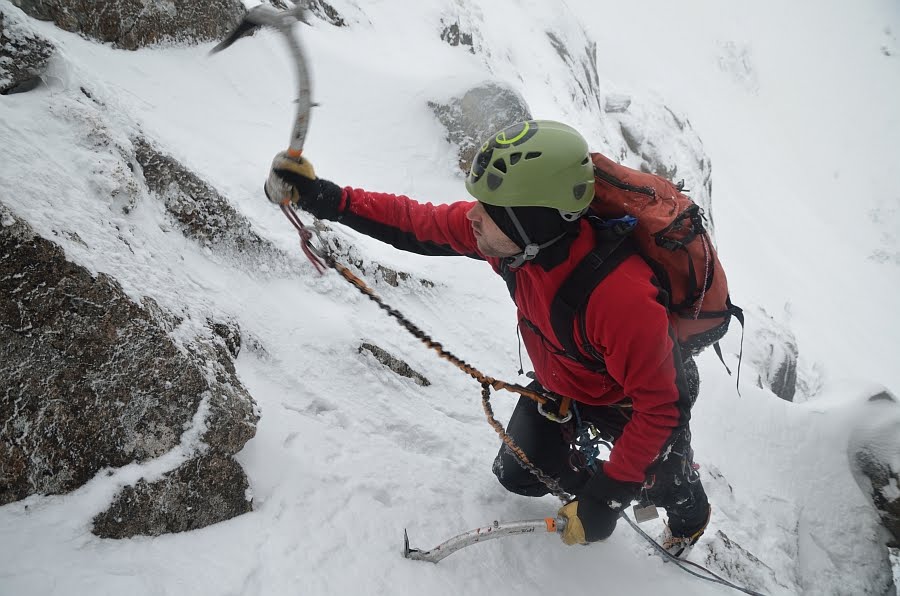
There was little snow on the rock but Jason’s chimney was, as the name suggests, a corner-chimney line which holds snow, ice and neve well and additionally has turf. It is the second chimney line to the right of hourglass buttress. I did the first pitch which was good tech 4 climbing and Robbie then the crux above which was a squeeze chimney.
The understated warning in the guidebook says a ‘traditional Cairngorms-style climb’ which translates into something that is comparable to wrestling with a wild boar covered in vaseline. At times I only saw Robbies right, cramponed foot scraping on the rounded granite but after a while he reappeared reborn above and soon reached a belay.
I initially tried to climb with rucksack but after getting stuck I sensibly tied the rucksack into the blue rope, squeezed through the chimney alone and then pulled the rucksack up. The third pitch was a short step onto a rib ...
...
...and then an easy traverse into the corner of Sickle ...
...and below a chockstone out onto the windless plateau.
...
We first walked the steep bit into the corrie and then bum-glissaded from half way up the corrie head wall...
...got our gear together and walked over frozen, heathery ground towards the burn where we saw a solitary walker with skis on his back, the first person all day. It was Adrian Crofton who had skinned and skied a Southern corrie three times. We walked to together to near the secret howff, collected our sleeping bags and with heavy rucksacks walked into the dusk ...
...to reach the cars at 18.30 h.

Beinn a Bhuird had delivered again. Jason’s chimney is a good climb well worth the walk in but only three pitches and in the Northern Corries there are many climbs of similar quality. However it is the wide spaces, wilderness, solitude and commitment that add an additional two stars to any climb in the corries of this great mountain.
HW

Monday, 16 January 2012

Aonach Eagach

The forecast for the weekend was good and bad because on the one hand the sun would shine but on the other hand only some ice routes on the Ben and maybe Braeriach would be in decent condition. So Robbie and I opted for a short-ish and sharp-ish training session over the Aonach Eagach. This Glen Coe ridge is a scramble and a grade II in winter route and was first climbed in 1895 by A.R. Wilson, A.W. Russell and A. Fraser. We expected and found spring conditions with some snow on the Northern apects whilst there was spring on the Southern side.

Here is a video of our Aonach Eagach traverse, showing some of the best scrambles.

We parked in the small car park near Allt-na-reigh and ascended often with a heart rate of around 160 bpm (yes, I took a heart rate monitor) to the summit of the Munro Am Bodach. Here I am half way up with Stob Coire nan Lochain and Bidean nam Bian on the Southern side of Glen Coe.

Some good neve higher up but overall very little snow for January.

Here is Robbie tackling the ridge proper whilst I did some interval training: take a photo and then sprint to catch up with Robbie.

Soon the first descent: a steep drop of about 20 m but all on big holds with some snow. We descended quickly but did neither break records nor bones. Here is Robbie also wearing crampons for the only time.

Some easier sections and here I am catching up with Robbie once again.

Good views and easy progress...

... and easy, in places wintry scrambling.

Finally the highlight of the ridge, the crazy pinnacles. Unfortunately no snow here.

After us team red demonstrating the eposure of this section and also the winter-spring contrast.

After the pinnacles the ridge is easier with a final rise to Sgorr nam Fiannaidh, the second Munro. Here we descended directly and then eastwards...


... to reach the car after 4 h 59 min. A good training day but not the climbing we wanted to do mid January!
HW

Sunday, 1 January 2012

Postern VI,6**: a long night on the Shelterstone

First winter ascent: M Hamilton, K Spence, A Taylor 5-6th of January 1980

After my holidays I had the Friday before Hogmanay free for climbing. Luckily Helen Rennard and Mark Mosgrove were happy for me to join their team. We decided to meet at 7.30 am at the Coire Cas car park in order to walk over to the loch Avon basin. We considered routes on the upper tier of Carn Etchachan but Mark said in a text message that ‘if the Shelterstone looks white it would be rude not to have at least a wee look at Postern...’. Helen and I also had Postern high on our tick lists and when we saw the white enough Shelterstone whilst walking and then bumsliding into the loch Avon basin our decision was made.

On the approach we spotted another team gearing up which turned out to be Iain Small and Susan Jensen.

No need to worry about being stuck behind a slow team then and also good to see two women tackle this big cliff in winter. Helen in our team is possibly the most active and/or accomplished female Scottish winter climber at the moment with a long list of impressive routes up to grade VII. Helen started our route by quickly despatching pitch one. There are some variations here and we climbed the turfy one to the right of Clach Dhian chimney whilst Iain and Susan climbed a snow-ice line to the left of the chimney.

Mark then led the delicate pitch two...

...

... and I the right slanting crack of pitch 4. On the photo below Susan is just finishing the trickiest section.

Good positions with mostly turfy climbing and hooking. When I arrived at the belay I saw Iain leading the impressive corner above which is marked by a wide crack. By then it had started to snow and it was windy. Mark and I had a look at the summer and winter topos of the Shelterstone in the SMC Cairngorms guide and we thought that the correct line was going left after the deep chimney and then right again to reach the top of the corner. Helen led the squeeze chimney and steep wall to a ledge well but because it was technical it took some time.

Both Mark and I struggled with the chimney due to our size and I had to let the rucksack and camera dangle on my right side to be able to squeeze through. Dusk descended whilst we stood on a small, exposed ledge high on the Shelterstone. The direct way up looked steep and poorly protected and we interpreted the photo topo to go further left and then right over broken ground. When Mark had finished this pitch it was dark and he stood at the bottom of a steep and long corner with a wide and more doable crack out of reach to the right. The corner itself was filled with unconsolidated snow and looked smooth and tough but I spotted flakes and thus gear on the steep left wall and decided to try that. Even if it was impossible to gain the large crack from there at least I could fix some good gear high up and then possibly down climb and attempt some thin or dynamic moves to reach the crack. The left wall was steep and pumpy with often only small features for feet but the gear kept coming and so after many hard moves I eventually managed to reach the corner at a point where the wide crack was close enough to bridge over. Whilst easier, the climbing was still strenuous and the final obstacle was an overhang at the end of the corner. Here I nearly came off as one crampon popped but managed to hold on to one of my axes. I hastily descended for a less pumpy position and got it right during the second attempt. Helen and Mark seconded steadily but as it was technical and pumpy it took a long time for all of us to meet again at the belay. This was well above the tech 6 that we had expected and I was low on sugar. By this time the temperatures had risen to above zero and the snow had given way to drizzle. Luckily there was a bit of a moon and we could see down a steep wall into Pinnacle gully even with the headtorch switched off. Helen led the next pitch which was a traverse to reach an exit to the plateau but she had to belay again as she was running out of rope. We were both very grateful to Mark for volunteering to lead another traverse on now slushy snow slopes above the drop. But when he started swearing, stopped, down climbed and had to belay again our heart sank as we thought that he was held back by a hard wall just below the plateau. Helen moved first on yellow and discovered that Mark was unable to move because the red rope somehow had got stuck whilst he was leading. Mark then easily topped out into the wet and strong wind followed by Helen and myself. It was 11 pm and so we had managed to spend 13 h on the climb despite climbing the bottom half quickly. I had my mapping GPS but the faint moon illuminated Hell’s Lum and the plateau allowing us to navigate by eye in the strong, wet wind. At times we saw and followed footsteps but it seemed a long time until the blue triangle hit the point on the GPS that said 'goat track'. A quick combination of slushy bum and foot sliding saw us on the Corrie floor and then Mark pushed us on against the strong wind to reach the Coire Cas car park at 1 am where we phoned our worried partners. I reached Broughty Ferry at 3.30 am wide awake due to two large cans of Red Bull. Overall we found that Postern is an excellent route which should not be underestimated. The fact that the very capable team of Murray Hamilton, Kevin Spence and Alan Taylor needed both the 5th and 6th of January 1980s suggests that it is epic-prone. The bottom pitches are obvious but at the top ensure to climb the corner with the wide crack in the wall directly rather than trying to traverse too far to the left and then back right as the guidebook topo might suggest at least to us. Maybe we have overlooked something and the corner direct is not too bad but the flakes on the left wall feel quite a bit harder than tech 6 and darkness did not help either. As a consequence we are now members of the exclusive Shelterstone 'long winter night' club whose membership has been steadily growing especially this year.
HW

Monday, 19 December 2011

Three new winter routes in Glen Clova

Glen Clova and the neighbouring Glen Prosen are the nearest winter climbing venues for Dundonians and also close to Aberdeen and Perth. In Glen Clova the two main crags are corrie Fee with the classic look C gully and winter corrie. However, when the recent Cairngorms guidebook came out I stumbled over the south facing North Craig where Greg Strange and Rob Archbold had put up a two pitch HVS summer climb named ‘High Plains Drifter’. This suggested that the crag must be steep and reasonably high. I think three years ago Ryan Slater went up in a thaw and fog to have a first look of the crag. Last year Robbie Miller, Andrew Melvin and I went up again in thaw conditions and saw surprising quantities of ice due to drainage from above but the ice was rotten as it was far too warm. Finally yesterday (17.12.2011) Arno Alpi and I decided to make an optimistic walk in as we had cold nights for a while and as the end of the week was frosty around the clock.

When we arrived we saw a lot of ice, we were out of the wind and the sun was shining! We did three routes and graded them according for ‘average’, less than ideal conditions. The routes are (see topo below):
1) White Plains Drifter IV,4* 45 m, red;
2) Whitewash IV,4 50 m, yellow;
3) White Sun of the Desert III,4 45 m, blue.

We encountered thin and hollow sounding ice making the climbing interesting at times but after a prolonged freeze on an icy day with sunshine most routes should be easily a grade easier, deserve more stars and the crag will be a mini Beinn Udlaidh (so we hope!). Presumably conditions will be good here if look C gully in Corrie Fee is in nick. We started with the most icy route. Unfortunately the ice was quite thin and hollow sounding especially the last 10 m at the top. Nonetheless, it is a rare privilege to climb ice in the sunshine in December in Scotland. Ask Pete Wisthal who experienced very different conditions on Lochnagar. Here is me near the top before the delicate stretch of ice.


Next was the corner to the right. It looked good but in pieces the ice was poorly bonded and fell off making the climbing a bit too exciting. Again it will probably be a grade easier when in good nick.


Arno then tried the final obvious gully line furthest to the right.


However the snowice on the steepest bit was hollow and so we decided entering the gully via the buttress on the left which is a grade III and will not change much with conditions.


Good fun climbing and an excellent day. Here is Arno on the way back.


Some detail for North Craig which was first explored by Greg Strange and Rob Archbold.
1) Approach: Ascent the Kilbo path, walk for about 500 m towards the summit of Mayar and then contour to find the south-facing crag at ≈700 m altitude. It is not named but marked as one black line on the 1:50,000 Ordnance Survey map about ≈500 in south-westerly direction below the summit of Mayar. Alternatively use any route to the summit of Mayar and descent to the crag. The location is NO239 733.

2) Map: http://www.streetmap.co.uk/oldmap.srf?x=323850&y=773350&z=115&sv=323850,773350&st=4&mapp=oldmap.srf&searchp=oldsearch.srf&ax=323850&ay=773350&lm=0

3) Routes
Summer:
High Plains Drifter HVS Greg Strange, Rob Archbold 2001. See SMC Cairngorms guide page 428.

Winter:
White plains drifter IV,4* 45 m. Climb the obvious, iciest corner. If the ice is thin or hollow the last 10 m can be precarious.

Whitewash IV,4 50 m To the right of ‘white plains drifter’ climb the obvious gully line with an ice step one third up. The route will probably be a grade easier if there is good neve.

White Sun of the Desert III,4 45 m On the first attempt the ice in the gully was fragile so the buttress to the left was climbed to gain the upper part of the gully via a few airy steps.
HW

Monday, 5 December 2011

Tainted Elixir V,6***: Northern Corries climbing on Ben Cruachan

No need to wait any longer: winter has finally arrived and Arno and I decided to combine plenty of hill fitness training with a short climb given the relatively poor forecast and the few hours of daylight. We decided on the Noe Buttress in Coire Chat (Ben Cruachan) which has only seen first ascents after 2000. We left Dundee at 6 am and here is Arno walking near the stream towards the Cruachan reservoir.

There was snow from 200 m upwards making the ascent to the 1126 m high summit of Ben Cruachan the hill fitness exercise that we were looking for.

From the summit the buttress is visible. Descend from the summit and walk maybe for 200 m on the ridge that goes to the West until you find East gully. At the bottom there is a good spot to gear up. It was Baltic with a strong, icy Westerly but the Eastern side of the crag more or less sheltered from the wind.

We decided to climb Tainted Elixir, a short, 70 m V,6*** first climbed by Chris Cartwright and Simon Richardson on the 14th of December 2003. The climbing was physical, technical and sustained and very similar to the best the Northern Corries have to offer. Gear was very good even despite the ice which required scraping and hammering. Here is Arno climbing. The steepness of the crag becomes apparent.

And here he is a bit higher.

I climbed the first two pitches as one and belayed below an overhang. The overhang was climbed with interest as the guidebook says but actually it was easier than it looked with lots of gear and good hooks, very satisfactory. After that some easy climbing to the crest. Because the climbing is so good and sustained the end was disappointing and it would have been nice if there was another pitch. On the other hand there are good looking routes to the left and right and so keen folk can easily climb another route. Here is me on the descent happy about the first route of the season.

At the end a sunrise over St Cyrus nature reserve on my way to Aberdeen. Whenever I get fed up with the dark Scottish winter days like yesterday and vistas like this make me forget all that gloominess.

HW

Sunday, 20 November 2011

Waiting for winter 2011/2012

Last November and in November 2009 we were already climbing winter routes. Not so this year. It has been unusually warm and so the only thing we can do is getting fit for the day when winter comes to Scotland. In Aberdeen there are few possibilities to train for winter but one is an old cottage ruin near the Aberdeen harbour lighthouse. It offers a half decent traverse which I did tonight on my way back to Aberdeen:

HW

Monday, 26 September 2011

Ben Rinnes

Currently we are running and walking some decent mileage to prepare for the Aviemore half Marathon. This Sunday, after a long run on Saturday, we tried Ben Rinnes for a wee hillwalk. An easy land rover track to the top although it was very windy in places.

It stayed dry with some good views over the Speyside Whisky country towards the Moray firth.

Christian and a granite tor I...

... and II.

Dark clouds but still no rain on the in parts soggy landrover track back to the car park.

Autumn is coming.

HW